Backward in Muzaffarnagar

A visit to the heart of the recent communal conflict in Muzaffarnagar confirmed two truths – that the rural, peasant Jat is polarized along religious lines; and that he is rudderless on how to progress in the 21st Century. The Jat gotra panchayats in Western UP and across the Yamuna in Haryana are controlled by status-quoist leadership, and their alignment with the Sangh Parivar has spread like a wildfire sweeping across a forest welcoming destruction.

The Jats are pitted against their own interests, which this obdurate community is often wont to do – they are head to head against the Muslims on whom they inter-depend for agricultural survival, they are increasingly aligned politically with the divisive thinking of the BJP which is using them for its ruthless political ends to gain political power in 2014 at any cost, and thanks to the crutches of job reservation the community is arrayed in self-defeating terms against the modern word that has beckoned them to progress for 30 years since their emergence as progressive peasants. Whether the BJP wins or the RLD does, the Jats lose.

Chaudhary Charan Singh

The Jats are a agricultural land owning, peasant community spread across Haryana, North Rajasthan, Delhi and Western Uttar Pradesh – they are numerically dominant in a limited number of districts in Western U.P., but they comprise a small 1.7% of UP’s 195 plus million population. The Jats were resurgent in the Seventies as part of Chaudhary Charan Singh’s rural alliance of the peasant Other Backward Castes (OBCs) along with the Yadavs (9% of UP’s population), and the sub 1% Gujjars, Tyagis, Kurmi, Lodh; and the numerically superior Muslims (18.5% of UP, and more than 30% in many West UP districts). Charan Singh was a peasant leader, painting an evocative picture of the hard working, small peasant oppressed by a self-seeking urban educated class comprised of the higher castes. He brought the OBCs together as a powerful political force for the first time in North Indian history, and the peasant communities amongst the Muslims were aligned with him as part of this unique combination of caste, class and religion. His grouse was economic, and so were the solutions he espoused in many well-argued books in his long political career that embraced legislation and advocacy of the peasant; while his political base was clearly caste and religion based. This conundrum – caste based politics that tried to subsume and transcend caste – was his most significant political strength, and his biggest hurdle to true greatness. He forged links of solidarity between disparate groups often arrayed in competition, and his personal incorruptibility, ability to deliver to his constituents and his clear rural ideology created a ferociously loyal base of followers across castes and religions who, since his passing, have been split unequally between Mulayam Singh Yadav (his long terms political protégé) and Ajit Singh (his son).

The Division Becomes Increasingly Complete

Congratulations, Sapa & Bhajpa. The Muzaffarnagar riots have turned out as you planned. It serves your interests to keep the Muslims socially, educationally, economically backward; and the once agnostic Jats more integrated into the Hindutva fold and vote bank. More masjids and Tablighi thinking; more temples, mindless rituals and superstition; and a sad loss of Insaniyat.

Tirath Mein To Sab Pani Hain

There is nothing but water at the holy bathing places; and I know that they are

useless, for I have bathed in them.

The images are lifeless, they cannot speak; I know, for I have cried aloud to them.

The Purana and the Qu’ran are mere words; lifting up the curtain I have seen.

Kabir gives utterance to the words of experience; and he knows

very well that all other things are untrue

The Songs of Kabir”, Translated by Rabindranath Tagore. 1915.

The riots troubled me no end since the fires first burned in September 2013  (https://amanbagh.wordpress.com/2013/10/25/we-are-all-complicit-the-muzaffarnagar-riots-of-september-2013/) and I wanted to go and see for myself once the rawness settled down, and not manufacture opinions from secondary sources with their own axes to grind.

I am able to wade fearlessly into the Jat community with opinions that cause them consternation. I was born of Jat parents, the term having no meaning for me now other than as a statement of origin of nomadic tribes that migrated into North India from Central Asia millennia back; and as another term for a peasant nurturing the values of thrift, hard work, honesty, integrity, humor and a fierce commitment to securing the ways of nature. I like to believe there was a tribal past, pre-absorption by Hinduism, where community feeling was based on these shared values. More likely it was not, and my commitment to humanism is a result of education in a Jesuit school, marriage to a Muslim and my continuing attempts to understand Islam in India, a Masters in the US, and 25 years in the software services industry meeting people of many nationalities and realizing that the economic root of exploitation, and the desire to dominate the weak, is common to people across the globe. My antipathy towards the leadership of organized religions is balanced by compassion for the mass of followers, who after all seek that elusive peace and happiness in a life marked by suffering.

Onto Muzaffarnagar

These are said to be the first riots to have infected the rural fabric in West UP. My intent was not to find on whom to lay blame or castigate one or the other for the riots, but to understand current Jat community thinking in the aftermath of the conflict. In any case, data proves that the Muslims in Muzaffarnagar villages were the ones who suffered most in terms of the dead and those displaced from their homes; so there was no need to further probe who is the oppressor.

I have often wondered why the social and political leadership amongst the Jats in the wide geographic swath – ranging from Saharanpur, Muzaffarnagar, Bareilly, Moradabad, Meerut, Bulandshahr, Ghaziabad, Mathura, Aligarh and Agra – has not urged the community to educate itself as the true long term cure for backwardness. I wrestle why the leadership fights for reservation as OBC as the only solution to backwardness, why there is no effort at setting up schools and colleges of caliber and leapfrogging other backward rural communities on the back of agricultural income invested in education of the intellect and the soul.  There are enough educated, erudite, professional role models amongst the Jats who have progressed beyond their caste roots, and can be held as ideals, but these remain in the background and in their stead regressive leaders remain in the fore. Short-term populism wins over at the cost of a long-term transformation of the community; and it without doubt the nature of their leadership who has an interest in the status quo.

In the early morning of a cold February day, I left Gurgaon to visit a village at the heart of the conflict. The drive took a quick 2 hours and a half on the highway well past Meerut, but a hour and fifteen on the last 30 kilometers as the potholes were to be seen to be believed on this rural stretch. This is the famous agricultural belt that feeds India with sugar, and huge trucks carrying enormous loads of sugarcane tortuously navigated the non-existent roads; and I wondered as my Jeep hit another 2 feet deep crater. I wondered if this horrible infrastructure is one of the causes of increased social tension. The peasant has no roads to take his produce to the markets, and the money earned by the state government is spent in other parts of the state – some say 70% income from West UP, and only 20% is spent here. In this highly politically literate area, no one has data to back opinions (the government obviously fudges it, and no legislator has either the time or capability to ask intelligent questions) but everyone paints floating visions of a conspiracy to eliminate Ajit Singh by Yadav badshah Mulayam.

Cleansing and Character

The entire population of Muslims had fled the village in October itself, at the start of the riots. Unlike the Jat converts to Islam – Moole Jats, peasant cultivators with land holdings and a robust self concept like the unconverted Jats – the 1,000 plus Muslims in this village were low castes: carpenters, blacksmiths, cobblers, petty shopkeepers, landless laborers. Today, their homes are deserted and not one Muslim remains behind. Not one. I can only imagine the violence, but the impact on the minds of those who stayed behind cannot be underestimated.

Now that I am farming in the peasant traditions of my ancestors, it was not difficult to connect with Pradhanji whose home we reached, past the eerily deserted homes of the Muslims at the edge of the village, after navigating narrow village lanes. I had taken the precaution of bringing along two other Jats from the area as insurance, with instructions to not share that I was Ch. Charan Singh’s grandson.

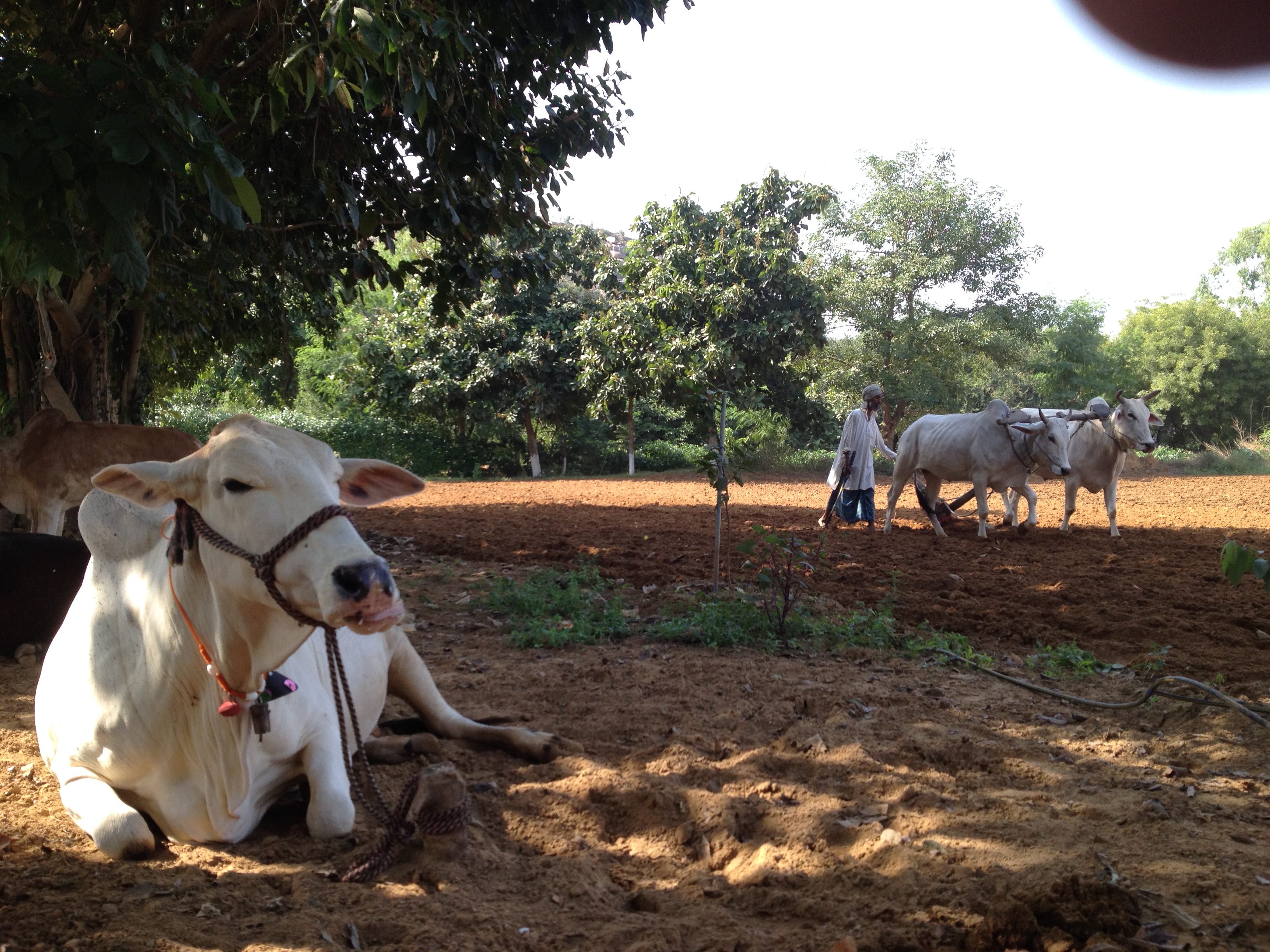
At Pradhanji’s home, where a cow chewed the cud under the peepul tree in the spacious and shaded courtyard, we also met with Masterji. Both are educated, one a BA and lawyer, and the other MA and retired head of a school. Both have large land holdings, one with over 10 acres and one with over 5 acres – great wealth in a region where most land holding peasants own less than 5 acres. These rough hewn men, pillars of the village community, were in their sixties, tall, robust and healthy neither looking a day above fifty. Both were gracious in their hospitality – tea, sweets, namkeen, milk – and surprisingly open in their conversation, and in their prejudice. Perhaps because they were sharing thoughts with a fellow Jat, they could not quite believe I would think different. When it dawned on them during the course of my 3 hours there that I was in disagreement, they were bemused at what they thought were my theoretical statements about amity and co-existence. They welcomed me to stay as a guest for a couple of nights, to really understand how disastrous these Muslims were.

What would they have said had they known that I employ 4 Meo Muslims and 1 Dalit (the cook, at that) at my farm in Faridabad, Haryana?

Pradhanji had the distinction of having given shelter to a couple of Muslim families for a night till they were handed over to the police to be safely escorted out of the village. He did this out of his sense of responsibility, he said, to Insaniyat. But he had no sympathy for their actions and way of being. Here his grey eyes flashed with anger, and we were off of the next couple of hours on a trail of half-truths and misunderstandings that have been formed into strongly held opinions by a majority of the non-Muslim communities in West UP. Surprisingly, though, our engagement was civilized. They listened to my thoughts without interruption, and they put forth their views in calm, measured khari boli. It was a far cry from drawing room conversations in educated Delhi, where the middle classes scream their thoughts at each other across an impassable divide of political alignments; but with very little knowledge of Bharat.

Pradhanji asked me if I knew that there was no “character” in any community in this area other than the Jats? The Muslims were backward and lived in hovels, with parents and sons with their wives sleeping in one room and going at it in the night (What was left to the imagination was the unspeakable and vicarious horrors of communal sex). And did I know that they married their cousins? What values can a community hold if a boy is encouraged to marry his sister? And who is a minority in Muzaffarnagar to be pampered – the Jats with 20% of the population, or the Muslims with 40%? Did I know a Muslim has many wives and many children and they will soon replace the rest of the communities? He compared his own self, and Masterji and myself with only one child each with these large families. Were we (included by default, I was one of them) not destined to be overwhelmed? For good measure, now that we were talking about backwardness, did I know about the complete absence of a work ethic of the Dalits in the village; who were happy to sleep all day in a drunken stupor than invest in a hard days work?

A religious bigot who believes in the stereotypes spread by the Hindutva brigade seems to have replaced the humorous Jat who got a kick out of ribbing the stereotypical fellow Jat, as well as the Bania and the Brahmin.

It is well documented by many scholars of which I quote Alaka M. Basu (from Unravelling the Nation: Sectarian Conflict and Secular Identity. Eds. Kaushik Basu & Sanjay Subrahmanyam) that “polygamy is slightly higher in the Hindu’s (5.8% compared to 5.7% among the Muslims)” and “….women in polygynous union have fewer births than women in monogamous marriages.” And “… every man who has four wives is leaving three men unable to have only one” and that “religious fertility differences are narrowing”. Most of the higher fertility of the Muslims – and yes it is higher, though falling – is due to social-economic depression of the Muslims and lower female education, and fertility will doubtless reduce as this backwardness is dispelled.  In J&K a Muslim majority state, Basu tells us, the fertility rates of the Muslim is lower than that of the Hindu.

Recollect the many stories over the years about Jat Khap Panchayats (and, to be fair, those of all other OBC and high caste groups in North India) opposing marriage within a gotra (a Malik cannot ever marry a Malik, or a Mann marry a Mann; and so on). For a Jat, marrying their gotra ‘sister’ is a social evil that cannot be countenanced, even if the common ancestor went back 500 years and the ‘sister’ after 20 generations is no longer really related. The opposing polarity between these two communities on the approach to marrying cousins and other cultural differences needs an inculcated ability of living with others who live differently, of co-existing. How will that happen if exceptionalism is the norm in the education system, and only the Hindu form of nationalism (and that too the singular Hindutva variety) and their culture being true for India?

The cause of the fear in the Jat community is their inability to adequately respond to change and modernity due to their weak education – and here I mean not only the quantity (12th grade or College) but the quality of education imparted (pedagogy, teachers, infrastructure, books, computers) and the social content i.e. how modern-liberal is the worldview imparted? The fear also comes from an accelerated breakdown in contemporary social structures in the village; movement by an increasing number to the town and city and resultant loss of traditions replaced by Hindutva rhetoric; and an existentialist threat to their traditional occupation of agriculture where the terms of trade are heavily weighed against them and alternative professions do not exist.

The Aftermath

Pradhanji and Masterji were clear that they were for punishing the guilty, but wanted a ‘fair’ enquiry – whatever that means. The administration, they said, was captured by the Muslim leaders of the Samajwadi Party (‘Ajam’ Khan) and they were convinced that a free investigation is not possible. I tend to agree with them, as the atmosphere is simply too heavy with politics and Mulayam Yadav does not want the truth out, he just wants to close this chapter and get on with the elections. Not surprisingly, Mulayam Singh has not yet visited the Muzaffarnagar riot hit villages. Masterji repeatedly stated that there has been no rape in the village – yes, there was arson, looting, violence, destruction of property – but no rape, no chance of it. In any case, what kind of a community is this that tomtoms rape – no self-respecting woman would stand up and accept she had been violated; so this was reason enough to suspect the accusers. In reality, the riot hit have filed many cases of rape against village youth.

There was some chance of reconciliation, I was told, (I wondered how the beaten & scared can sit across a table to ‘reconcile’ other than to cave in) but it had all been defeated by the filing of rape charges under criminal portions of the police code. The lives of these young men would be devastated, for who would marry them with a criminal case against them? In any case, the village were on alert and no policemen allowed into the village to make arrests. If they did come with force, blood would flow. Then, and I heard this from many, Muslims in the riot affected villages get 5 Lakhs from the government to sign off their right to return to the village in exchange for the compensation; so many people had made false statements and had obtained their money and moved on.

In this atmosphere, where everyone has an opinion and no one has the facts, it is clear that insaniyat has suffered terribly and the wounds of the deep cleavages between communities will remain raw for decades. The aftermath is segregated Hindu Muslim villages, which by itself lead to more misunderstanding and increase the real and imagined spaces between the communities.

Goodbye

I returned on the potholed roads, reminded of neglect of the development of the region as a cause of social tension.  But that did not hold to explain the horrific violence and widespread destruction of an entire ecosystem. The socio-economic backwardness of the Muslims is not addressed by their leadership, or by the leadership of the state government and the administration. The Jats are bought over by the forces of Hindutva obscurantism, and are moving from a rural peasant community where formal religion played a peripheral role to being the vanguard of the campaign to embrace a movement that teaches an exclusivist religious nationalism. Unless an alternate vision can come to their rescue, majority of the rural communities in West UP seem lost for some time to Hindutva.

Naya Shivala (New Temple)

I’ll tell you the truth, O Brahmin, if I make so bold

These idols in your temple – these idols have grown old.

From them you have learned hatred of those who share your life,

And Allah to his preachers has taught mistrust and strife;

Disgusted from your temple and our shrine I have run,

Now both our preachers’ sermons and your old myths I shun.

In shapes of stone you fancied God’s dwelling-place: I see

in each speck of my country’s poor dust, a deity.

Come, let us lift this curtain of alien thoughts again,

And reunite the severed, and wipe division’s stain:

Too long has lain deserted the hearts warm habitation;

Let us build in this homeland a new temple’s foundation!

And let our shrine be taller than all shrines of this globe,

With lofty pinnacles touching the skirts of heavens robe:

And there at every sunrise let our sweet chanting move

the hearts of all who worship, and pour the wine of love:

Strength and peace too shall blend in the hymns the votary sings,

For in love lies salvation to all Earth’s living things.

“Naya Shivala”, Mohammad Iqbal (1873-1938)

I stopped at one of the many Kohlus on the way back, the local jaggery making crushers, and bought gifts for my farm hands back in Faridabad, and for home. After all, Muzaffarnagar produces the sweetest Gur and Shakker in India.

Posted in Communalism, Rural Village Life | 3 Comments

Welcome, Summer

IMG_1506

Harvesting Mustard – 15 March 2014


Today was Holi, the festival of colors. I noticed, driving through empty Gurgaon roads to Aman Bagh, the (surprising?) commonality between wealthy Gurgaon condominium residents and rough hewn Gujjar peasants  – loads of alcohol, bhang, pot; and loud, sense deadening music. No holi music, not even a ‘Rang Barse’. Drinking, doping and music have been a part of Holi since ever – but it seems the intensity was different, alcohol was not this free, the music not as loud and not as mindless. As one gets older, the past takes on a warm glow so …..

The Tota Tree in Flower

The Tota Tree in Flower at Aman Bagh

We are at the end of फागुन (Phalgun) – approximately 22 February to 22 March – going into चैत (Chaitra), the commencement of the long hot seasons till अशविन (Ashwin) in October. Spending time so close to nature, I realise seasonal changes are specific markers for farming activities that have evolved over millennia and have been honed to perfection through practice. Each season brings its own imperatives – my peasant professors of agriculture at Aman Bagh have harvested the mustard on one acre in 2 days,  laid it out to dry so the seeds can be separated later this week; we will then take the seed to the local village mill into oil for our consumption and oil cake and hay for our cattle. The stems of the crop are already lined up for use as firewood.

The ingenuity of the peasant, and the hard environment, ensures every part of the crop is consumed by man, woman or beast and nothing is wasted. Its quite amazing really, the ease and smoothness with which this complex cycle is executed. And it will be repeated next week in the जौ (barley) crop, in early April for wheat and the chana and masoor crops. 

The fruit trees and saplings – mango, grapefruit, kinnow, lemon, guava – have been manured with cow dung slurry and leaf humus; and are in full flower (other than the guava). The scent of the grapefruit flower is sweet and strong, while the lemon flower is less so but yet quite arresting as you walk past.

The sun was hot, and the day already longer by an hour since February. The weather quickly cooled down by 5 PM, and dusk was ideal weather for our cattle to enjoy the first night tied out of the shed. They were a bit foxed – cows are sensitive beings, they don’t like change of any kind – but settled down within an hour to doing what they do best : eating. Boring is good, the present is all that matters. Even cows can teach you, if you want to learn.

Many things to do in the coming days – the cow shed mud and dung walls replaced with cement plaster; summer vegetables planted; flower saplings moved from the nursery to the beds; a new front wooden gate to replace the current iron one; and additional drip and sprinkler irrigation installed.

Nature ensures one lives in the present while tilling the land. Whatever – whatever – comes next is natural, expected, even if not known; there is no need to worry as we know what is to be done next. And even if it hailstorms or goes dry, that too is kind of expected and is to be handled. A peasant farmer is a master of doing, working, no matter what.


Posted in A Day in The Life, Crops | Leave a comment

Shri Bhupinder Hooda and Mr. Larry Bossidy

Judging by the full-page advertisements released by the Congress government on 1 January 2014, Haryana’s population is in a state of bliss with free medical care and medicines, cattle loans, loan interest waivers, crop insurance and what have you. The list of other freebies – for laborers, numberdars, chowkidars to Anganwadi workers, women, army personnel, government employees – in the “Bonanza worth Rs. 3,000 Crores ….” is endless.

Mr. Bhupinder Hooda’s current government – professional politicians, corrupt bureaucrats, their crony businessmen and wheeler dealers – has played the ruthless game of entitlement politics well this past decade, and from all accounts has made money hand over fist in the process. But so did the Chautala clan, Bhajan Lal, and Bansi Lal before him (‘sab chor hain, babuji” my farm hands say). Today the culture of corruption is endemic and deep rooted in all parts of Haryana’s social and cultural life, with public institutions demolished, and Hooda’s government is more morally debased than the reprehensible Chautala regime.

Rajan

Rajan

Ask Rajan, a 45 year old who works and cooks at my agricultural farm in Faridabad district, and she is emphatic that she has not got one rupee benefit from the schemes of the Haryana government in the last 25 years. And she knows nothing of any of these or other schemes I share with her as I have read the advertisements over the last year. My farm is just 12 kilometers from the million population plus cities of Faridabad and Gurgaon, so we can well imagine the situation in distant parts of rural Haryana.

Rajan is the ideal candidate for assistance from the government.  She is dalit, landless, widowed, with two sons who are poorly educated, without a work ethic or values, and are currently unemployed. Her elder son worked for some years as a JCB driver at an illegal crushing zone in Faridabad, and contracted tuberculosis that the government doctors in Faridabad could not treat. A private doctor in Delhi gave him the right antibiotic course, and he is well on the way to recovery. So much for free medicines – if there are no doctors, what will medicines do?

Rajan’s experience reflects – amongst other things – the complete absence of a culture of execution in government, where an announcement is considered the equivalent of having delivered a promise. In reality, 90% of the money will be retained by middlemen and sharks from amongst the politicians and bureaucrats and the ever suffering Haryanvi citizens would have been robbed twice over – first, through heavy taxes by those who can afford to pay; and second by stealing the money before it reaches the citizen. Jab Raja Chor Ho To Kaun Bachaye?

An average strategy executed well brings superior results compared to an outstanding strategy executed averagely. Execution has been elevated to a level higher than strategy by Larry Bossidy and Ram Charan in “Execution: The Discipline of Getting Things Done”. Hooda will do well to read this and understand that execution cannot be delegated to other lower down in the chain while he focuses on poll strategy. But he won’t read this as he and his political class aren’t bothered about real results for real people (like Rajan), he just wants to win the next election and gather enough capital for the coming generations to remain on top of the grasping, greedy, sweaty bunch of professional politicians.

Execution is the job of the leader, and the gap between strategy and execution has swallowed many a promising leader in well-run companies. Good execution means consistency in delivered results, day in and day out, year after year.  Good leaders build a laser sharp vision for the organization; bring positive energy to all they do; personally seek out and build a team of like minded executives; focus the company on a few key goals; actively measure the results and reward performance through an efficient MIS and scores of pre-scheduled meetings weekly, quarterly, annually. The even more fundamental key to building a successful company is self-awareness of the leader herself – introspection, striving to scale as the company grows, and that rare quality of humility.

It’s not that all business leaders execute outstandingly, but I know that a whole lot try really hard, and with sincerity. The art of execution is worth emulating by those in the service of society in each state of our Republic – public sector executives, bureaucracy, and politicians. If there was process and measurement (hence efficiency) in administration, no new strategies or plans would be required. We’d be rid of many of our problems within a decade. Simplistic? Maybe. But “keeping it simple” is often a good idea.

But unfortunately a basic premise doesn’t stand scrutiny – that politicians and bureaucrats in Haryana are there to serve society and not only their personal ego’s; that they desire to improve the lot of their suffering citizens and are not there for garnering wealth for their next 20 generations; and are not suffering from son blindness. Across the political spectrum in Haryana, the situation is bleak.  The BJP is no alternative to corrupt politics in Haryana having tied up with Mr. Bhajan Lal’s son, neither do they have the caste coalition to win the elections to be held later this year. Mr. Chautala and his sons bestowed many favors when in power, and continues with a core following in the Jats but it’s difficult to fight elections from jail 🙂 Maybe the Congress will come back after all, and that is really a depressing thought.

Unless the AAP wins the 20 odd urban & semi-urban Assembly seats and some from the 65% of the population in the rural areas. Just the thought is enough to make anyone breathless.

Posted in A Day in The Life, Rural Village Life | Tagged , , | Leave a comment

January 2014 – a Day at Aman Bagh

It’s a bracingly cold January afternoon, and the sun is strong – a wonderful winters day. Nature is at its most peaceful at Aman Bagh at this time of the year – winter is a relatively laid back season as the busy planting season is over, and life moves at a happy, slow pace as we wait in anticipation of the harvesting season in March & April. This is the Rabi – spring in Arabic – crop.

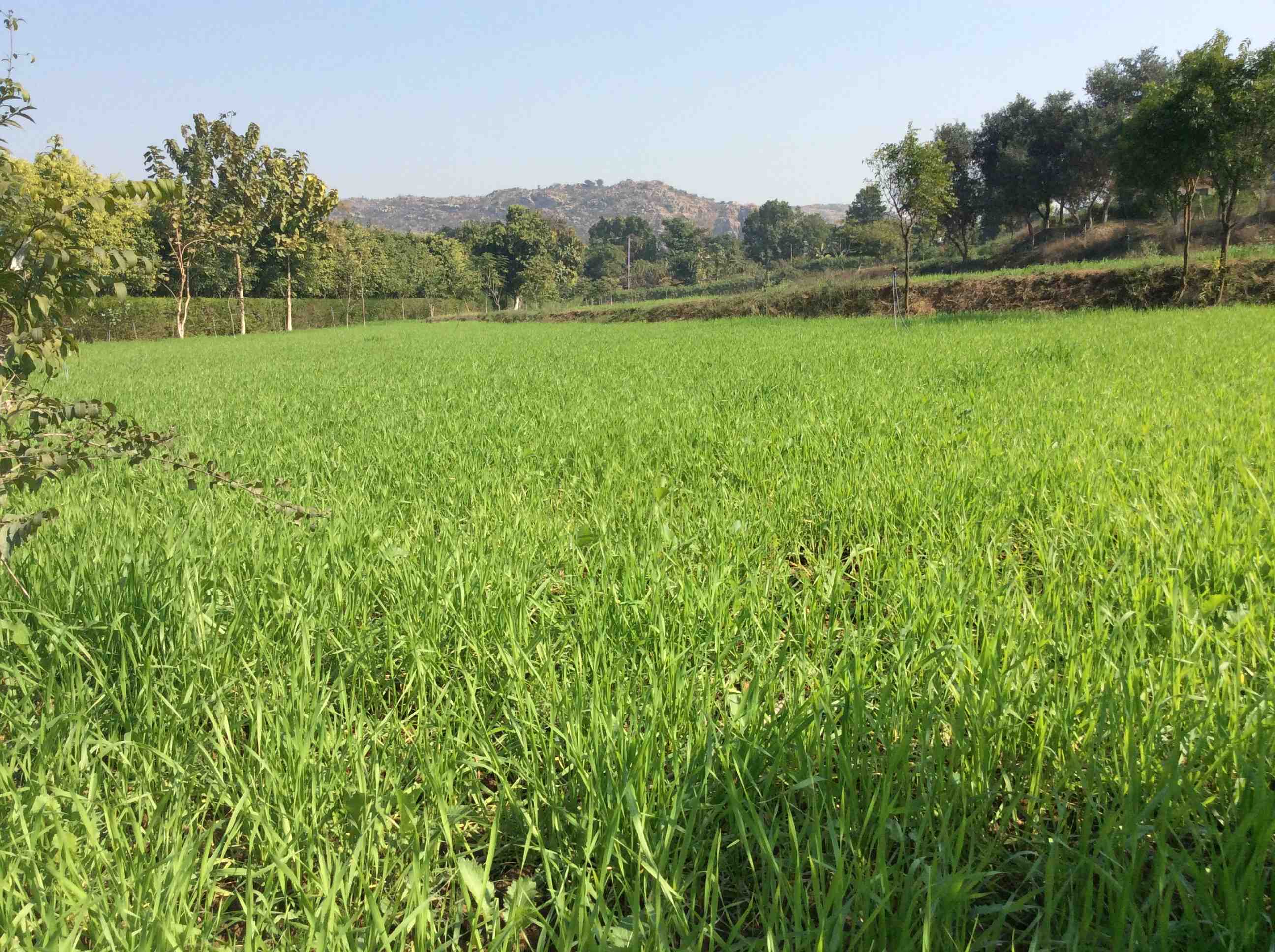
The desi (MP tall 352) Gehun was sown mid November and is now one foot high – and healthy. It’s 2 acres of a quiet and sweet green, balm to the eyes and the soul.

Wheat 3 Jan 2014

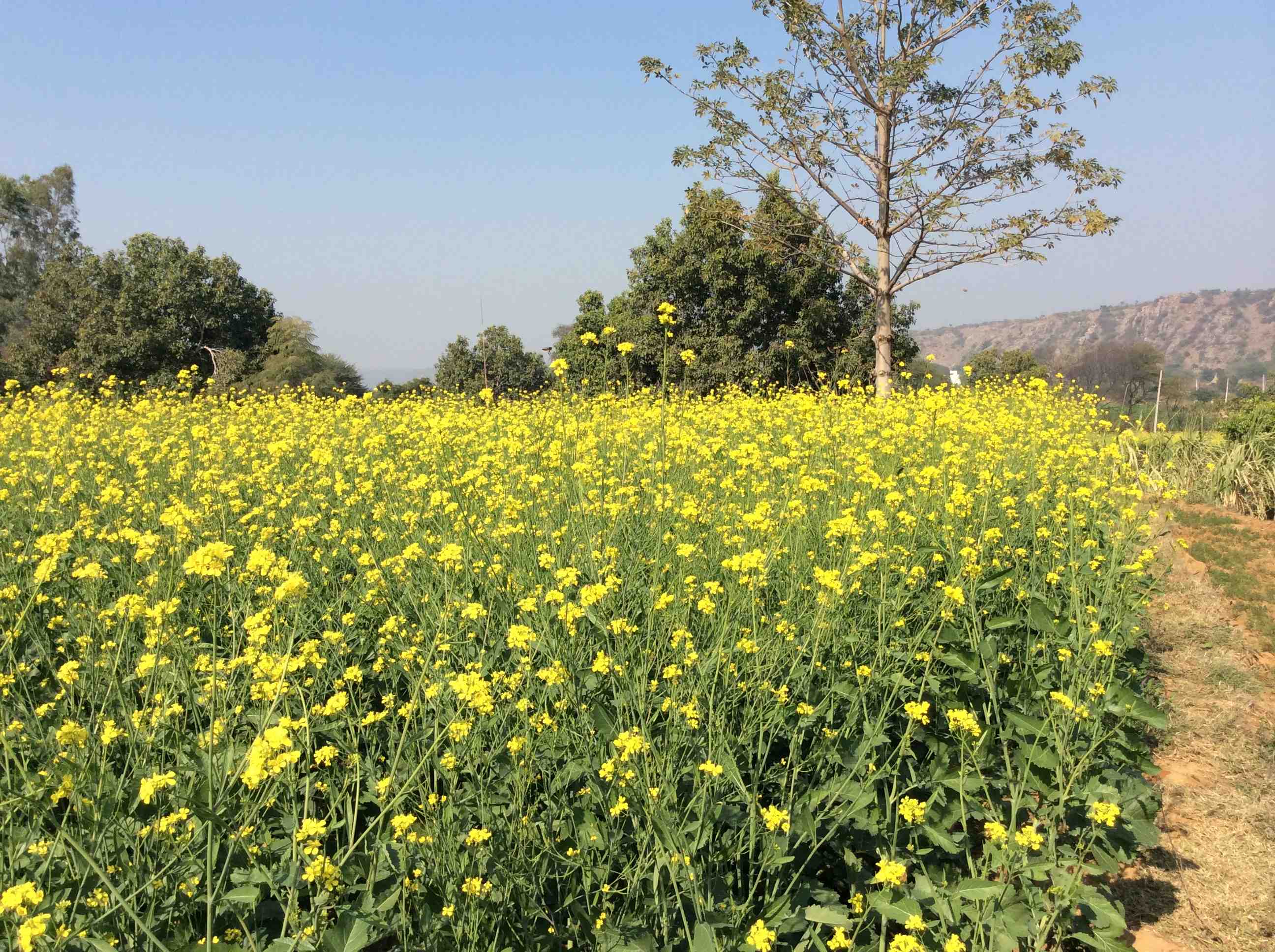
Our desi Sarson was sown on 1 November and is already 5 foot high, each plant with thick and strong stems; flowering bright mustard. Nothing quite as beautiful as ripening mustard, heavy with flower, swaying in unison with the winter breeze. Many peacocks and peahens walk around, enjoying the safe haven of Aman Bagh.

Sarson 3 Jan 2014

Jau was planted end October in a smaller patch, and has grown to 1½ feet; it will reach 4 feet by March when it would have ripened. Desi Chana (Kabuli & Black) was sown at the same time as Sarson; these too are doing well with tiny leaves spreading out from their low, thick clumps. Other green growth (doob, chatmatri, khandimandi, papra, bathua, kharatua) was removed today and – other than kharatua – have all been fed to our cows as nyar, with the chana standing clean and free in the field.

The Amrood trees are 18 months old and 10 feet high with thick central stems and balanced side branches, and gave us a few sweet fruits last summer and this winter. They now all have new lilac coloured shoots and leaves, the effect of winter and sufficient water & manure; and we look forward to their crop of Safeda fruits in the coming monsoon. Our mature Aam and Chakotra trees are in hibernation, waiting for warm February to flower; the 18 months old citrus – Kagzi & Bara Nimbu, Chakotra, and Kinnow – saplings have given off early winter shoots; but are yet one year away from first fruiting.

The soil these healthy crops & fruit trees are growing on was fed manure (2 tonnes for every acre) from our 10 heads of desi cows, bullocks and their young ones. Besides the traditional talent my local farm hands possess in terms of knowing how and when to sow and water the crops, the health of these crops and trees is without doubt due to our liberal use of cow dung manure & leaf compost and the many by products used as micro-organism soil re-chargers and organic pesticides.

It’s cold, windy and quieter as the sun sets and everyone hunkers down for another freezing January night in Faridabad – it will be 2 degrees Centigrade tonight. The plants and trees wait silently for February, without complaints as we have fed them with adequate nutrition and love.

Posted in A Day in The Life, Crops, Links to Organic Farming | 4 Comments

Bullocks !

These two 2 years young bullocks of the Hariana desi breed cost us Rs 14,000 with a wooden plough thrown in. Purchased from a local Gujjar farmer in the Mangar hills, they are hardy and well suited to our environment. Shamsher and Dalsher are easy tempered, and they now get nourishing feed to make them strong for the next 10 years of service to our land. We would have loved to get a pair of big, beefy, white Nagori bullocks but that entailed an expense of Rs 40,000 to 60,000 and transport from West UP or Rajasthan – too much effort and money.

Bullock Cart c. 1950

Dalsher and Shamsher. December 2013

The bullock cart is 50-60 years old, from Western U.P., restored lovingly to its original self. When we drive around on the village road, villagers passing us in their cars road look at the cart – surprised, quizzical and zapped, just as they used to look up from their carts at the rare car that whizzed past them 30 years back.  How the world changes, and remains the same. 

These two bullocks suffice for our small farm. I came across a useful extract from a report from the United Provinces Director of Agriculture written in 1948, and nothing has changed in 2013:  “The cultivator generally expects to run 10-15 acres with a good pair of bullocks under moderately intensive farming in the west of the Province. In the east of the Province, with ordinary bullocks, he controls 5-8 acres. A pair of bullocks is thus sufficient for the cultivation of 6-15 acres, depending upon the kind of agriculture and the strength of the animals. To keep a pair for a much smaller area is uneconomic but it has to be done in a large number of cases.”

Are bullocks relevant in this age of tractors, and sophisticated mechanical farming attachments? Yes ! they are appropriate technology for the 100 million small and marginal peasants (less than 5 acres) who constitute 80% of all farmers in India. (Yes, this is data for 2010, not 1948). Tractors cost a fortune to a peasant on the fringe of survival; they guzzle diesel worth tens of thousands a year and ruin the national trade balance; and they produce tons of noxious greenhouse gases that poison all of us. All three are good enough reasons for us to think and support of alternate ways to till the soil.

Thus – unlike the tractor – the bullock is inexpensive, needs minimum maintenance at low cost, does not harm the environment, provides dung as inputs to the gobar gas plant, for fuel, and for fertilising the field. The relationship with these simple animals is a bonus, and connects us to life in a way no machine ever can.

However, this does not sit well with the urban Indian or with the modernising mindset – we are impatient for progress, without knowing the costs to society and quite oblivious to how most of our rural economy is structured. If there are no bullocks in the US or Europe, that’s good enough for many of us. Large farms need tractors, but these (more than 10 acres) constitute less than 8% of our farm holdings. We need solutions for the vast impoverished majority along with the (relatively) richer minority. In any case, farming is not a money-making profession, even for the larger peasants. A peasant will make more money – and lose his way of life and his self-respect – by driving your car rather than farming his 10 acres.

The government can support a scheme of “shared bullocks” in villages that can be rented by the marginal farmer; and can breed better (hardier, stronger) desi breeds of bullocks – as well as save the current ones being born today from the slaughter house where most land up.  There are many ways, if there is the desire and capability of alternate thinking.

Posted in A Day in The Life, Bullocks, Rural Village Life | 9 Comments

We are All complicit: The Muzaffarnagar Riots of September 2013

Image

My heart was seared by the words and images of communal violence in rural Muzaffarnagar in September 2013, and a part of me died when I heard and lived the stories of horrific destruction and the unbelievable and mindless cruelty of peasants on fellow peasants and neighbours. Increasing divisions of caste and religion have destroyed the togetherness that farming has traditionally brought – there is more in common between the communities of rural UP than they (in their small and inward mindedness) imagine. Food, language, clothes, local architecture and the rhythms of nature bring them together such that they belong nowhere else, in no other country, on this planet but together. I hold on to the stories of hope where a brave Jat landlord helped shelter and protect terrified Muslim families, women and children from marauding groups of villagers of his community. I will play my part to help heal these divisions between brethren of agriculture, knowing fully well that something has changed forever.  People need a friend to lean on in the aftermath of a cyclone.

Jat and Muslim; panchayat, politician and minister; policeman and bureaucrat are all complicit – each in a way unique to the failed state of Uttar Pradesh. These were the first communal riot to engulf the rural areas of West UP since people remember; areas that always remained violence free (if not tension free) when the nearby urban areas were lit up in communal flames. These riots are seminal in another way – they signify a near final breakdown of the bonds of peasant agriculture and a rural identity based on shared peasant and agriculturist economic interests – across caste and religion – crafted over 5 decades (1935-1985) by Ch. Charan Singh. The leadership space thus vacated was under threat by caste and communal forces these past three decades since his demise in 1987, as seen by the growth and superimposition of alternate identities of Hindu and Muslim by the BJP and the SP (who lost the mandate of the Jats to RLD, but retained the massive Yadav and Muslim peasant support base of Charan Singh). Make no mistake, the responsibility of these Muzaffarnagar riots lies with the large number of Jats and the Muslims who participated – ‘outsiders did it’ is a cop out. But many others are complicit – a visionless, weak and increasingly ineffective Jat leadership in the RLD; scheming and plotting BJP card holders wanting to increase their hold on the Jat community; Muslim leaders of a similar ilk from the SP desiring to control the Muslim vote; and a paralyzed Chief Minister and administrative apparatus that failed the innocent. It was a perfect storm.

Peasant togetherness has retreated in the face of commercial agriculture and the destruction of a millennia old way of rural life; and the natural aggressive impulses of the dominant Jats (out of proportion to their numbers) is driving them into mindless darkness. The Jats need to rethink their place in agrarian society as it transforms to urban and semi urban, as their coercively dominating ways are challenged by the downtrodden rising to increasingly seek their future through education. When will they see the light, and who will show it to them as those who lead are themselves blinded by personal aggrandizement.

The Jat community in UP has visionless leadership, fragmented across multiple political parties and increasingly belligerent, feudal and intruding caste panchayats. A fragmented and internecine combative leadership has not been able to create or provide a development and economic vision of the future. Absence of such a positivist leadership that rallies the community around a progressive future will cause more tension in the villages as they increase in prosperity by selling their land holdings – a focus on liberal (as opposed to solely job oriented) education in schools and colleges, a revolution in the emancipation of their women, and an entry into the a world of liberal thought and action. Where is this leadership?

Indeed, these riots are a natural culmination of a long process of degradation in rural civil life – Western UP agrarian society is wealthy in parts, with enormous income disparities, caste ridden as ever, feudal and seeking domination of the weak, leaderless, and without a model for economic, intellectual or cultural progress (“where is rural society headed? What is progress? And what are the economic & cultural models and measurements for such progress?”). The irony is this degradation and deadening of sensibility afflicts all agrarian castes and religious communities in West UP in a democratic manner.

I am horrified by the loss in life, homes and property of a backward, impoverished and futureless Muslim community in rural Muzaffarnagar, a cultural and economic situation they share with their brethren in other parts of prosperous Western UP.  A majority of those killed in these riots were Muslim, which gives rise to a reasonable conclusion that they bore the brunt to Jat ire as a result of the girl-boy root of the conflict. It matters little who and what started the killing to those who died, to those who lost their livelihood and homes, to those who lost hope and are now living a life of hate and mistrust. And where is the progressive Muslim leadership who educates their children, emancipates their women, and provides access to new ideas? Alas, the situation of the Muslim leadership in West UP looks even worse than that of the Jats.

Solutions can be found only if agrarian society led by a selfless leadership interacts across castes and communities and debates the problems and seeks solutions from the people. Can peasant agriculture be retained as a way of life in increasingly wealthy Uttar Pradesh, where wealth is measured in acres of land for sale not for cropping? Where is chemical farming and the resultant poisoning of the soil taking the land and its people? Is education a focus for those who are now wealthy thanks to this chemical-commercial farming? What kind of education do the many private ‘English medium’ schools and the government schools provide? Are teachers in these schools free from a communal and casteist attitude, and can they be guides for the children under their care to help them grow into broad minded, tolerant young adults? And where are the jobs allied to and outside agriculture? What do young people do – they are educated enough to be aspirational and not want to work on the land, and illiterate enough to not to be of any use to the few jobs cornered by the urban educated. Why are there no job opportunities created around agriculture related small and micro sectors, around the villages and census towns? Why is there no entrepreneurship funding and micro financing for women and unemployed youth from rural communities? What about handicrafts made by self-help women groups? Organic farming and distribution of organic products to the cities, specially the consumer rich NCR? Rural tourism for the city folks?

No one debates the way agrarian society should develop, and what is the end game of development other than making money at all costs. Commerce is king, and everyone is happy to exploit the people, keep them under domination; especially leaders who should be showing the mirror to their flock and taking them on a path less trodden.

Image

Posted in Communalism, Rural Village Life | Tagged , | 5 Comments

Breeding Invasions of a Different Kind

I recently watched “Breeding Invasions: Livestock At Stake” a sensitive and thought provoking documentary produced by Anthra, an unusual organization “ …..of women veterinary scientists working primarily on issues of livestock development in the wider context of sustainable natural resource use.” It’s inspiring to see qualified scientists like Sagari Ramdas and Nitya Ghotge commit their lives to issues related to the livelihoods of the marginalized, poor and landless when they could very well be leveraging their premier animal sciences qualifications for commerce.

These are the people on whose backs India is fighting a rear guard war with the forces of industrial agriculture and corporatized dairy farming, and all power to them.

Anthra makes a passionate case for retaining the traditional integration of livestock and agriculture with the livelihoods of our rural population, while they document the dramatic degradation of this many millennia old relationship in parts of Andhra Pradesh and Maharashtra. And the ‘old’ story of pollution of the environment and food cycle by multinational company produced chemical fertilizers, pesticides; and thoughtless fossil fuel based mechanization.

We hear villager narratives of the influx of foreign cattle breeds intended for enhanced milk production but ending up diseased or dead with the burden of purchase and medical loans on the farmer. Another instructive narrative is around the indiscriminate destruction of indigenous breeds in the industrial production of poultry – the producers themselves do not eat these birds as they their feed and nutrition value is suspect, and they continue with the desi hens for personal consumption. The privatization of village commons for the benefit of the powerful and dominant village castes is a result of an absence of understanding of the rural economy by bureaucrats who sit in distant urban areas unconnected to the daily pain and frustrations of their rural brethren who et constitute 68% of India’s population. The small and marginal farmer (these are 330 million people), the dalit, landless and tribal (400 million) need policy support to build on their traditional methods of livelihood that enhance the resources currently available to them.

Sanjeev Ghotge comments made me think about the application of appropriate technology and what is therefore the appropriate level of mechanization in our overwhelmingly rural country where labor is freely available and land and capital are scarce. We cannot wish away the rural populace, or enhance land holdings. But why use a tractor that replaces 12 bullocks, emits 1 ton of noxious fumes a year; and uses 3 tons of costly imported diesel annually? We also lose the manure of these 12 bullocks, which could fertilize 5 acres of land organically. Why not extensively enhanced veterinary extension services by the government for breeding better stock (cows, bulls, buffaloes, goats, sheep, poultry) from our indigenous breeds. I can see scores of pet shops in Gurgaon providing health services for dogs and cats, but not one half interested partly trained vet when I need him most for my cattle at the farm. When he comes, he is eager to give an expensive allopathic injection – not to treat the cause, or even understand the cause. What afflicts doctors treating humans is the same disease that hits the cattle doctors – antibioticitis.  They retain no knowledge of indigenous systems and cures, and all they can do is prescribe allopathic medicines that cost a lot and often don’t work as the problem identification was so poor. The vet is mostly unavailable, is inadequately trained, and only commerce minded.

Liberalization means the government abdicates its role to the private sector, and pay-and-be-serviced becomes the only model. What we need is a carefully nuanced withdrawal of the government in sectors where the private sector can be more efficient (hotels, airlines, retail, telecoms) with a strong oversight and regulatory framework; and a more activist and interventionist government role in areas like animal husbandry, cattle veterinary services, and agriculture extension. All I see is a retreat of the government in all areas, indiscriminately and without thought for the millions who need it the most.

Why not better bullock carts with suspension and brakes – carts that are lighter and speedier? How do the farmers transport their produce to the nearest markets when we know that private diesel based transportation is prohibitively expensive and destroys the profit for small and marginal farmers? Why not provide loans for the use of healthier and better bred bullocks hitched to better carts?

Breeding local cattle and poultry with the significant investment of the government behind it can work, what is needed are bureaucrats who have lived and worked in the villages and understand rural India in its many manifestations in our disparate 28 states. What is real in the rural areas of Pune cannot work in Faridabad in Haryana, but the framework of making agriculture, dairy and poultry local can be common.

Posted in A Day in The Life | Tagged , | Leave a comment

Desi Cows – on the route to extinction ?

Jay Mazoomdar wrote an impassioned cover story in Tehelka on the Indian cow recently – http://www.tehelka.com/the-desi-cow-almost-extinct/ – this has valueable knowledge for the lay reader interested in learning how India is throwing away its cattle heritage developed over many millenia. We have only 37 odd desi cow breeds left in India (see http://eng.gougram.org/breeds/ for a list), and all are under threat of being overwhelmed by hybridization and thus losing their unique adaptation to our sub continents many micro climates. Not simply because of the tyranny of the market economy and the never ending search for increased production, but a lot due to short sightedness of our agriculture and dairy policy makers who have mindlessly given up on desi cow and low total system cost that she brings versus the imported hybrids.

I recently connected on mail with Anthra – a collective of women veterinary scientists in Andhra Pradesh working on issues related to livestock and livelihoods. See this video to get an idea of what they do : http://www.youtube.com/watch?v=lTAya1M-so. Anthra has published what looks like an interesting book on holistic animal health, and I hope to learn from their traditional, natural methods to add to our fledgling practice of homeopathy for our cows. (On a side note, why do all the progressive things to be tried in agriculture seem to take place in Andhra, Tamil Nadu and Maharashtra? Haryana, Punjab and West UP are deep in the race to increased production and selling their land to the highest bidder.)

Aman Bagh has 5 desi cows : 2 Sahiwal, 1 Nagori and 2 Hariana. Our land cannot support more cows in terms of  their food requirements, and their dung is sufficient manure for our acreage. One of the fundamental practical requirements of a traditional farm is the presence of cows or other cattle so that the traditional farmer has fertilizer to replace the chemical ones they don’t use.

More importantly, we know each one and provide individual care  – they are part of the community at the farm. Any more than 5 cows takes us into commerce of a different kind, and that is not our purpose. Aman Bagh is here to be a self-sufficient farm in terms of organic inputs, not in revenue. If we wanted to make money, farming would not be the chosen profession ! Aman Bagh is proving a point –  traditional farming is holistic and respects the environment and all the living beings dependant on it, has output equivalent to chemical farming and can be a model for small farmers, the food produced tastes so much superior than chemical farming and is good for those consuming it, and (while it is a lot of work) anyone can practice this kind of farming if they want to. Come visit, see and share.

We are evaluating replacing one of the Hariana with a Sahiwal, and my man friday Sattar and I visited a Goshala 6 km ahead of Sultanpur where we were happy to see 30 desi cows in clean surroundings – mostly Rathi and a few Sahiwal. These are good looking cows, and each time I see a pure Sahiwal, my mind goes to the majestic Mohenjo Daro bull circa 3000 BC. How can we ever let this heritage slip from our fingers.

Now you know why we have pledged to keep only desi cows and bulls at Aman Bagh.

A Sahiwal cow

A Sahiwal cow

2013-09-11 16.58.34

A Sahiwal Bull

Mohanjo Daro Zebu Bull

Mohanjo Daro Zebu Bull

Posted in Cattle | Leave a comment

Farming as a Way of Life, and Not Just Commerce

Kheti Dharma Hai Vyapar Nahin – Farming is a way of life, a value system, and not just commerce

To paraphrase Masanobu Fukuoka, Aman Bagh’s reason for existence is to “cultivate better human beings and not just grow crops”. This gives me the energy to evolve in a certain direction and, in addition to becoming a responsible farmer and consumer, it enables me break boundaries of caste, community, and the nation to connect with people across the globe who believe in a compassionate world free of coercive domination.

Our operational objectives at Aman Bagh are self sufficiency (‘no external inputs’) & sustainability (commencing a positive life cycle that is self-generative). Many more farmers – and consumers – in India think like this today, and India has the benefit that much of the world does not – thousands of years of organic farming practices mastered by our peasant ancestors. It’s exciting to be part of this movement, nascent though it is.

There is much that I need to learn about natural farming, and unlearn about ‘scientific’ pesticide and chemical free agriculture put forward by agricultural scientists and academics. The only way is to live the agricultural life, and practice, practice, practice.

The start point of this process of learning in May 2012 was to accept that I know very little about how nature keeps the earth productive. Then learn how this cycle takes place and mimic this at Aman Bagh; and re-discover and implement what my peasant ancestors practiced for a thousand years or more (in the same area where Aman Bagh is located). Another element of this process of self education was to look beyond what agricultural scientists and universities, pesticide companies, fertilizer companies and urban society feeds us (they need the employment, and the commerce) and start instead to listen mindfully to the rhythm of nature behind this confusing din intended to crowd out logical thinking and awareness

http://www.youtube.com/watch?v=kyGbevifc3U. This video is a useful overview of the organic farming movement in Maharashtra and states in the South of India. Farmers in Haryana and Uttar Pradesh,  the Yamuna-Ganga alluvial plains in India where I hail from and where so much knowledge on natural farming is embedded in rural society,  are too busy making money from selling their land and converting their life to the fast lane mimicking the rapidly burgeoning cities and towns. I’m headed in the reverse direction — artisanal, slow, and sustainable.

Aman Bagh

Aman Bagh

Posted in A Day in The Life | Tagged , , , | 2 Comments

Pesticides & Fertilizer schedule

Here is my annual plan for fertilizer (Panchgavya, Jeevamrit, Gobar Gas Slurry) and pesticide (Keet Virodhak) applicationFert & Pest Schedule Sept 2013.

This schedule has been written in Hindi on a large sized A5 paper, color coded and laminated (so it can last the seasons outside) and made with Nooru (who administers this single handedly). It’s all about execution : this has been impressed on Nooru that this is his single most important duty, and he must follow these schedules without a break and without a deviation. 

This took us 9 months of reading and research; and visiting and meeting with organic farmers like Subodh Abhi. (http://sylvanheightsfarm.wordpress.com/). Subodh is a gentle and quietly inspiring farmer, practicing Agnihotra farming in the foothills of the Himalaya’s. Subodh was the first to guide me to the Ginger-Garlic-Chilli-Cow Urine combination that works so well as a prophylactic pesticide spray for all our crops today (details on how to make this elsewhere on the Fertilizer & Pesticide page). When needed, we add suitable amounts of Neem oil – the quantity varies from 100 ml per 16 liters to 300 ml, depending on the plant and the pest we want repelled. Experimentation is key, and each farm & crop will find its own balance through experimentation.

My grandparents certainly did not know of these kind of preparations, and this is where sharing practices across India helps grow the organic movement and make it a match for chemical farming in the head to head comparison of ‘production’. As if that is all matters, but more of that in a separate post.

Posted in A Day in The Life, Crops, Links to Organic Farming | Tagged , , , | Leave a comment